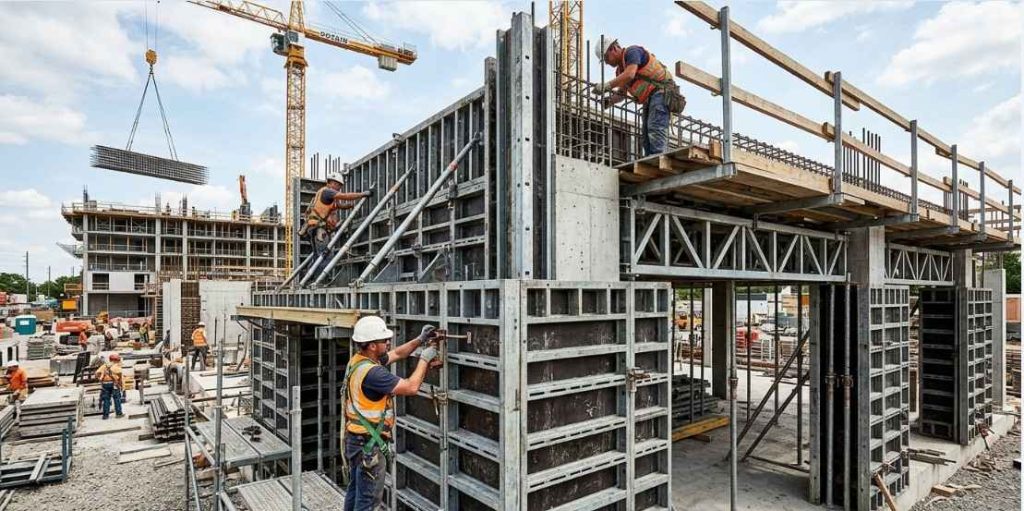
Shuttering is one of the most critical processes in modern construction because it directly affects the shape, strength, and quality of concrete structures. It is widely used in buildings, bridges, roads, and infrastructure projects where concrete needs temporary support before it hardens. In simple terms, shuttering acts as a mould that holds wet concrete in place until it gains enough strength to stand on its own.
In construction engineering, shuttering is also known as formwork. It plays a key role in ensuring structural accuracy, smooth surface finish, and safety during construction. Without proper shuttering, concrete can deform, leak, or fail to achieve its intended design strength.
What is Shuttering in Construction?
Shuttering is the process of creating a temporary mould into which fresh concrete is poured so it can take the desired shape and size. Once the concrete is poured, the shuttering supports it until the material hardens and becomes self-supporting.
According to construction practice, shuttering must withstand the pressure of wet concrete, vibration during compaction, and the weight of workers and equipment during the setting phase. After the concrete reaches sufficient strength, the shuttering is carefully removed.
In most cases, shuttering is used for:
- Columns and beams
- Slabs and roofs
- Foundations and retaining walls
- Bridges, tunnels, and water tanks
Studies in construction management show that formwork and shuttering work can account for nearly 20 percent to 25 percent of total structural cost in a project, making it both essential and cost significant in large-scale construction projects.
Importance of Shuttering in Construction
Shuttering is not just a supporting structure, it directly impacts construction quality and performance.
Structural accuracy
Proper shuttering ensures that concrete elements are built exactly according to design dimensions. Even small errors can lead to misalignment in beams or columns.
Surface finish quality
Good shuttering reduces defects such as honeycombing, rough surfaces, or leakage marks. A smooth formwork surface leads to better architectural finish.
Load resistance during construction
Wet concrete behaves like a fluid and applies pressure on mould walls. Shuttering must resist both static and dynamic loads during pouring and vibration.
Safety during construction
Stable shuttering prevents sudden collapse of formwork systems, protecting workers and equipment on site.
Types of Shuttering in Construction
1. Timber Shuttering
Timber shuttering is one of the oldest and most flexible methods. It is made using wooden planks and is commonly used for small construction projects.
Advantages:
- Easy to install and modify
- Low initial cost
- Suitable for custom shapes
Limitations:
- Less durable
- Absorbs moisture
- Limited reuse capacity
2. Plywood Shuttering
Plywood shuttering is manufactured wood material used for sheathing and lining of formwork systems.
Advantages:
- Smooth surface finish
- Lightweight and easy handling
- Better durability than timber
It is widely used in residential and commercial construction due to its balance between cost and performance.
3. Steel Shuttering
Steel shuttering consists of steel plates and panels joined with bolts and clamps. It is commonly used in large infrastructure projects. In heavy-duty construction where accuracy and reusability matter, advanced systems like AFTON Steel shuttering formwork system are often preferred by contractors for faster execution and long-term cost efficiency in repetitive structural work.
Advantages:
- High strength and durability
- Can be reused many times
- Produces excellent surface finish
It is ideal for repetitive structures like tunnels, bridges, and industrial buildings.
4. Aluminum Shuttering
Aluminum shuttering is widely used in modern housing projects because of its lightweight handling and speed of installation. For projects requiring precision panel alignment and repeated usage cycles, systems like SIRL SC formwork 3000X500X2mm offer strong dimensional accuracy and smooth concrete finishing, making them ideal for large-scale slab and wall casting.
Advantages:
- Easy to handle and assemble
- Faster construction cycles
- High reuse efficiency in mass housing projects
However, it has limited flexibility once designed and manufactured.
5. Plastic Shuttering
Plastic shuttering uses modular plastic panels that are lightweight and easy to assemble.
Advantages:
- Corrosion resistant
- Easy cleaning and reuse
- Suitable for repetitive small-scale housing projects
6. Special Formwork Systems
Modern construction also relies on advanced modular systems to improve speed and reduce labor dependency.
In high-rise and repetitive structural projects, solutions such as SIRL SC extensible formwork 500X500 are highly effective as they allow flexible adjustment and efficient casting of complex concrete elements while maintaining structural precision.
Advantages of Shuttering in Construction
- Ensures structural stability
Shuttering provides essential support to wet concrete until it gains sufficient strength, preventing collapse, leakage, or deformation during the setting process. - Improves construction speed
Modern shuttering systems allow quick assembly and dismantling, which significantly reduces overall project timelines and increases on-site efficiency. - Enhances surface quality
Properly designed formwork ensures a smooth and even concrete finish, reducing the need for extra plastering or surface corrections after curing. - Enables complex designs
Shuttering makes it possible to construct curved structures, arches, and customized architectural elements that would otherwise be difficult to achieve. - Cost efficiency in the long term
While initial investment may be higher, reusable systems such as steel and aluminum shuttering help reduce overall construction costs across multiple project cycles.
Common Problems in Shuttering
Even experienced builders face issues if shuttering is not done correctly.
Some common problems include:
- Leakage of cement slurry
- Bulging or misalignment of formwork
- Poor surface finish
- Honeycombing in concrete
- Difficulty in removing shuttering
These issues usually occur due to poor material selection or improper installation.
Best Practices for Shuttering Work
To achieve high-quality results in shuttering work, professionals use strong, well-treated materials and ensure tight joints to prevent leakage of cement slurry. They also apply formwork oil for easy removal and smooth surface finishing.
Before pouring concrete, proper alignment is checked carefully and shuttering is removed only after adequate curing time. Skilled labor is used for installation to ensure accuracy, safety, and overall construction quality.
Top Scaffolding and Ladders Used in Shuttering Applications
- AFTON Aluminum Double Extension Ladder – Safe high reach access for shuttering alignment and inspection work.
- AFTON Aluminum Straight Ladder – Stable support for formwork checking and site-level shuttering tasks.
- AFTON Telescopic Dual Purpose Ladder – Flexible height control for precise shuttering installation work.
- AFTON Aluminum Scaffolding – Double Width Mobile Tower – Secure elevated platform for shuttering, slab, and beam work.
- AFTON Cuplock Scaffolding System – Strong support system for heavy shuttering and large concrete structures.
- AFTON H-Frame Steel Scaffolding – Reliable framework for safe shuttering support and construction alignment work.
AI Overview
Shuttering in construction is a temporary mould for wet concrete that ensures strength, shape accuracy, and safety. Learn types, uses, and benefits for modern building projects.
FAQs
What is shuttering and types of shuttering?
Shuttering is a temporary mould used to hold wet concrete until it hardens and gains strength. Common types include timber, plywood, steel, aluminum, and plastic shuttering systems.
What is F1 F2 F3 F4 formwork?
F1 to F4 formwork refers to different levels of surface finish quality in concrete construction. F1 is basic finish while F4 is the highest quality smooth architectural finish.
What are the five types of formwork?
The five main types are timber, plywood, steel, aluminum, and plastic formwork systems. Each type is selected based on cost, project size, and required durability.
What is the purpose of shuttering?
The main purpose of shuttering is to support and shape wet concrete until it becomes solid. It ensures structural accuracy, strength, and a smooth surface finish in construction.
Conclusion
Shuttering plays a vital role in modern construction by ensuring that concrete structures achieve the required shape, strength, and finish quality. From small residential buildings to large infrastructure projects, the right shuttering system improves safety, speed, and accuracy while reducing long-term construction costs. With advancements in materials like steel and aluminum formwork, construction processes have become more efficient and reliable than ever before.
As construction technology continues to evolve, the demand for durable, reusable, and precision-based shuttering systems will keep increasing, supporting safer and more sustainable building practices across the industry.
Ready to Build Strong and Safe Structures?
For dependable construction solutions and high-quality industrial support products, Abul Fazl Trading remains a trusted partner, delivering reliable equipment and materials that help ensure efficiency, safety, and excellence in every project.