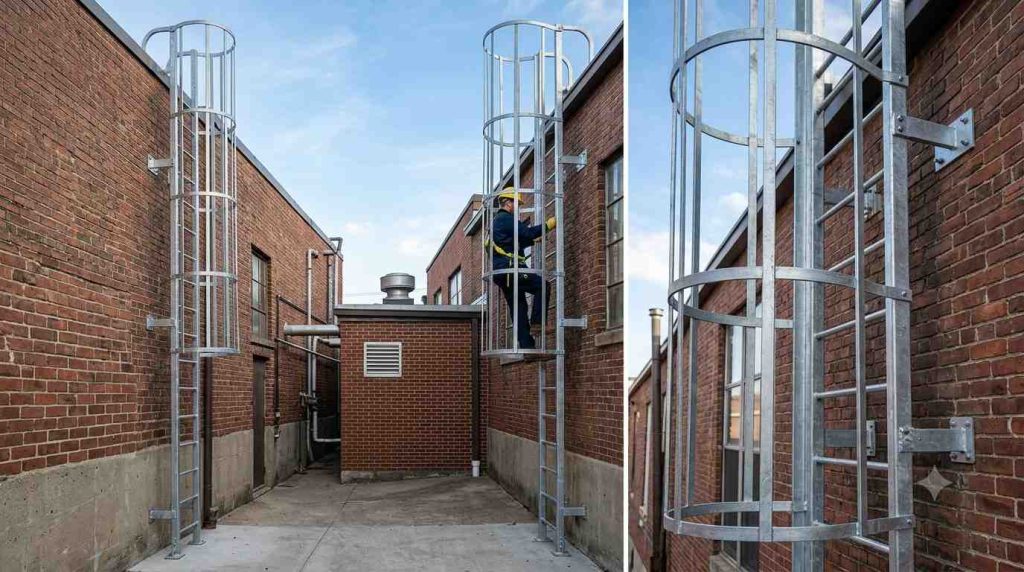
In industrial buildings, safe vertical access is a core engineering requirement, not an option. CAT ladders (caged fixed vertical ladders) are widely used for roofs, platforms, and machinery access in industrial facilities.
CAT ladder installation in UAE requires strict ISO 14122 compliance for safe vertical access systems. These ladders ensure structural safety, load stability, and long-term durability in demanding industrial environments.
Understanding CAT Ladders in Industrial Applications
A CAT ladder is a fixed vertical access system equipped with a protective safety cage designed to prevent falls during climbing. It is typically fabricated from galvanized or stainless steel and permanently mounted to structural walls or steel frameworks.
These ladders are commonly installed for:
- Roof access for HVAC and maintenance systems
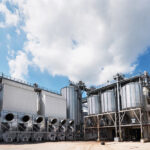
- Industrial tanks, silos, and storage units
- Mechanical platforms and factory mezzanines
- Utility structures requiring frequent inspection
Facilities requiring permanent roof or equipment access can benefit from our industrial fixed ladder UAE solutions, engineered for strength, durability, and long-term industrial performance.
Safety Standards and Compliance Requirements
Installing a CAT ladder requires adherence to recognized international safety guidelines, including:
- ISO 14122 (Safety of machinery – Fixed access systems)
- EN 14122 (European standard for access ladders and platforms)
- Local HSE (Health, Safety & Environment) regulations
These standards define key requirements such as load capacity, cage dimensions, rung spacing, fall protection measures, and structural anchoring strength.
Typical industrial ladders are designed to withstand point loads between 2.0 kN to 4.0 kN, depending on application and usage conditions.
Step 1: Site Preparation & Layout
Proper planning ensures safe installation and structural stability.
Assess Substrate
The wall or supporting structure must be evaluated to confirm it can withstand required loads. Industrial ladders are typically designed for point loads ranging from 2.0 kN to 4.0 kN, depending on usage conditions and standards.
Verify Clearances
Ensure the base landing area is clear of obstructions. Entry points should include controlled access systems or lockable gates to prevent unauthorized use.
Mark Anchors
Accurately measure and map bracket positions. Standoff brackets are typically spaced at intervals not exceeding 3.0 meters vertically to ensure uniform load distribution.
Step 2: Bracket & Ladder Installation
This stage establishes the structural foundation of the ladder system.
Drill Anchor Holes
Drill holes at marked positions using appropriate drilling equipment. For concrete surfaces, perform pull-out tests on chemical anchors to verify structural integrity before full installation.
Mount Brackets
Secure wall brackets using heavy-duty mechanical or chemical anchor bolts. Each bracket must be tightly fixed to ensure zero movement under load conditions.
Choosing professionally manufactured steel cat ladder fabrication UAE services ensures every bracket, rail, and component is built for demanding industrial environments and long-term performance.
Assemble Ladder Sections
Align ladder stiles (side rails) with mounted brackets and connect sections securely. The ladder must maintain a climbing angle between 75° to 90°, ensuring safe vertical ascent and descent.
Step 3: Safety Cage (Hoop & Strap) Assembly
The safety cage is a critical fall-prevention component of CAT ladder systems. A properly engineered safety cage ladder system enhances fall protection and compliance, making it an essential investment for industrial buildings with permanent vertical access needs.
Cage Entry Height
The bottom of the safety cage must begin at a height between 2.0 m to 2.2 m from the lower landing area.
Build Hoops
Install top, middle, and intermediate hoops using high-strength bolts and nuts. These hoops form the circular structure of the safety cage.
Install Straps
Cut vertical strap materials to required lengths and remove sharp edges. Attach these straps inside the hoops using bolts to create a continuous protective enclosure.
Attach to Ladder
Drill approximately 10 mm holes through ladder stiles and securely bolt the assembled cage system to the ladder structure. Ensure alignment is uniform and free of deformation.
Step 4: Egress & Handrail Safety Systems
This step ensures safe transition at elevated access points.
Roof/Platform Landing Extension
Extend ladder stiles at least 1.1 meters above roof or platform level to provide secure hand support for users transitioning on and off the ladder.
Safety Gates
Install self-closing safety gates at roof or platform entry points. These gates prevent accidental backward falls and ensure controlled access.
Proper egress design significantly reduces the risk of fall-related injuries in industrial environments. For complete rooftop protection, many industrial facilities pair CAT ladders with our industrial handrails UAE solutions to create a safer and fully compliant access system.
Step 5: Final Inspection & Testing
A comprehensive inspection ensures compliance and operational safety before commissioning.
Check Fasteners
Inspect and tighten all nuts, bolts, and anchor points according to manufacturer torque specifications.
HSE Compliance Check
Verify that all components meet local safety regulations and industrial HSE requirements, including signage and fall protection systems.
Load Testing
Conduct a static load test of approximately 2.0 kN to confirm structural strength and stability. The ladder must show no excessive deflection or structural movement under load.
Step 6: Additional Safety Inspection Checklist
Before final approval, ensure the following:
- Ladder is perfectly vertical and properly aligned
- No sharp edges or welding defects are present
- Safety cage is continuous without gaps
- All anchor points are chemically or mechanically secure
- Anti-slip rungs are properly installed
Only after passing all checks should the ladder be certified for operational use.
Safety Best Practices During Installation
Industrial ladder installation involves high-risk work-at-height activities. Key precautions include:
- Use certified fall protection harness systems
- Avoid installation during high wind or rain conditions
- Restrict site access during mounting work
- Use only trained installation technicians
- Follow permit-to-work (PTW) procedures
Even minor installation errors can significantly increase long-term accident risk.
Maintenance After Installation
CAT ladders require periodic inspection to ensure continued safety:
- Inspect every 6–12 months depending on usage
- Check corrosion on bolts and brackets
- Ensure cage integrity is maintained
- Replace damaged rungs or fittings immediately
- Re-tighten structural fasteners when needed
Preventive maintenance extends ladder lifespan and ensures compliance with safety audits. Regular maintenance is equally important after roof access ladder installation UAE projects to preserve structural integrity and extend the service life of your access system.
Common Installation Mistakes to Avoid
Many industrial failures occur due to poor installation practices:
- Incorrect bracket spacing leading to structural instability
- Missing or incomplete safety cage sections
- Inadequate top landing protection
- Using non-rated anchors for heavy load conditions
- Ignoring corrosion protection in outdoor environments
Avoiding these mistakes is essential for regulatory compliance and worker safety.
Conclusion
CAT ladder installation in industrial buildings is a highly technical process requiring strict ISO 14122 compliance, precise structural alignment, and full safety integration. When installed correctly, it ensures safe, reliable, long-term vertical access for industrial maintenance and operations.
For professional CAT ladder design, fabrication, and installation services across the UAE, Abul Fazl Trading LLC provides high-quality industrial and architectural fabrication solutions, delivering precision-engineered access systems built for safety, strength, and long-term performance.
Contact our team today to discuss your project requirements and get a customized quotation for reliable CAT ladder installation services in the UAE.
Explore More Related Guides
- How to Choose the Right Handrail Fabrication Company in UAE: Expert guide to selecting UAE handrail fabricators.
- What Is a Cat Ladder? Essential Guide and Uses:: Complete guide to CAT ladder safety, types, and industrial uses
- Dual Purpose Ladders Explained: Features, Benefits & Uses: Learn where dual purpose ladders offer the most versatility.
- Choosing the Right Fiberglass Ladder Manufacturer in UAE: Key factors to consider when sourcing fiberglass ladders.
- Warning Signs It’s Time to Replace Your Ladder: Identify safety risks before they lead to accidents.